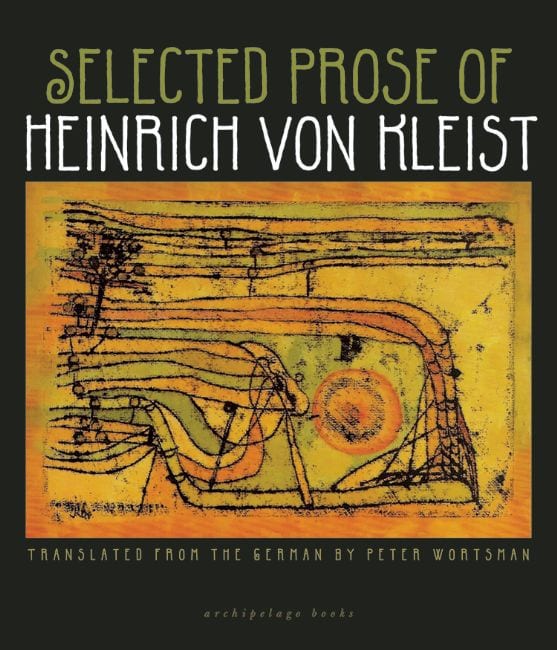
Book Description
In this extraordinary and unpredictable cross-section of the work of one of the most influential free spirits of German letters, Peter Wortsman captures the breathlessness and power of Heinrich von Kleist’s transcendent prose. From “The Earthquake in Chile,” his damning invective against moral tyranny; to “Michael Kohlhaas,” an exploration of the extreme price of justice; to “The Marquise of O . . . ,” his twist on the mythic triumph-of-love story; to his essay “On the Gradual Formation of Thoughts While Speaking,” which tracks the movements of the unconscious decades before Freud; these tales, essays, and fragments confront the dangers of self-deception and the ultimate impossibility of existence in a world of absolutes.
Kleist left behind a corpus of works that, while small in quantity, were and still are among the finest German texts.
— Library Journal
Kleist’s narrative language is something completely unique. It is not enough to read it as historical—even in his day nobody wrote as he did. . . . An impetus squeezed out with iron, absolutely un-lyrical detachment brings forth tangled, knotted, overloaded sentences painfully soldered together. . . and driven by a breathless tempo.
— Thomas Mann
This collection of short stories, novellas and literary fragments . . . is impressive not only for its content but for its relevance centuries later. . . . A dark, charming collection of twisted fairy tales for grownups.
— Publishers Weekly
Exploiting to the full the rigors of German syntax, he uses language to impose order and meaning on a profoundly disordered world. Clause follows clause in a stately, dispassionate procession of appalling events, commas marking time, paragraphs and even single sentences stretching on inexorably for line after line. Catastrophes unfold in a subclause. Idiosyncrasies of word order defer full, terrible understanding to the last possible moment.
— Ian Brunskill, The Wall Street Journal
[Kleist's] work is full of fatalistic paradoxes, harsh ironies, and fruitless attempts to make sense of an incoherent reality. The titular hero of his great novella is a horse trader who has two of his animals seized and mistreated by a corrupt nobleman . . . With typical Kleistian irony, a petty theft has become a chaotic peasant rebellion.— Robert Rubsam, The Atlantic
Dazzling. . . . Mesmeriz[ing]. . . . A collection of superbly crafted stories and essays that span cultures and centuries but deftly exposes the universality of human tragedy.
— Three Percent
A gift to fans of German literary history. . . . Wortsman preserves much of Kleist's difficult sentence structures and punctuation, and succeeds at modernizing Kleist's sometimes antiquarian prose. The selection is streamlined, yet carefully balanced, thus giving readers all of Kleist's necessary lunacy and narrative brilliance.
— Christopher M. Ohge, The World
The stories do not pause for breath; even less so in Wortsman's translations, which seek to convey the intricately enmeshed patterns of Kleist's syntax, so that, for example, the hundred or so pages of Michael Kohlhaas seem almost a single sentence. Once one engages with Kleist's narration, its peculiar urgency forces attention even as the plot spins into unforeseen byways.
— Geoffrey O'Brien, Bookforum
What makes Kleist truly 'modern' is his insistence on the aesthetic significance of the world around which we must journey.
— Paul Bishop, Journal of European Studies
As a storyteller, he ranks most naturally with Kafka, who admired him and learned from him.
— Sigurd Burckhardt, The Hudson Review
Michael Kohlhaas. . . . a story I read with true reverance.
— Franz Kafka
Includes fictional classics such as "The Marquise of O"; "Michael Kohlhaas," one of the greatest tales of revenge and justice; and what might be considered one of the great pre-Freudian essays, "On the Gradual Formulation of Thoughts While Speaking."
— The Bloomsbury Review
The work displays Kleist as a master of narrative language, the often epigrammatic style mirroring the grotesque thematic material.
— Review of Contemporary Fiction
In the hands of von Kleist, paradox and dramatic irony are not literary devices but rather fundamental features of ordinary life.
— The Quarterly Conversation
In essence, Kleist consistently subverts our expectations. Like the earthquake in Chile, his fiction causes the apparently solid ground beneath our feet to shudder, crack, and, finally, give way.
— Barnes & Noble Review
His narratives are taut with psychological tension . . .
— Ruth Franklin, The New Republic
. . . the way that Kleist spirals the illogical actions of his characters amidst implausible events in a matter-of-fact tone balances the stories’ volution on a precipice that is singular even now.
— Words Without Borders
Peter Wortsman’s direct and fluent translation makes this an accessible introduction to Kleist for English readers . . .
— Times Literary Supplement
The single greatest influence on Franz Kafka, the greatest writer of the 20th century, through whom his work is often "telescoped", Kleist left behind a slim body of work that speaks to and haunts us, more relevant than ever in our time.
— Bibliophile Bookbase